Projekt LoRaWAN: Unterschied zwischen den Versionen
Inhalt gelöscht Inhalt hinzugefügt
Leo (Diskussion | Beiträge) |
Thm (Diskussion | Beiträge) Keine Bearbeitungszusammenfassung |
||
| Zeile 79: | Zeile 79: | ||
* Ein auf [https://www.espressif.com/en/products/hardware/esp32/overview ESP32] basierendes Developer Board dient zur Demonstration der Fähigkeiten von LoRa |
* Ein auf [https://www.espressif.com/en/products/hardware/esp32/overview ESP32] basierendes Developer Board dient zur Demonstration der Fähigkeiten von LoRa |
||
* [[LoRaSensor| Anleitung zum Nachbau gibt es hier]] |
* [[LoRaSensor| Anleitung zum Nachbau gibt es hier]] |
||
== LoRa Netzwerkkonfiguration == |
|||
Folgenden Schritte haben wir unternommen damit alles funktionierte: |
|||
Geräte: |
|||
* AP1.52 (hat auf eth0 192.168.11.52) |
|||
* LoRaWan GW: 192.168.5.30 (siehe [[Adressierungsschema]]) |
|||
* Netzwerkkonfiguration in /etc/network/interfaces |
|||
# Ethernet |
|||
auto eth0 |
|||
allow-hotplug eth0 |
|||
iface eth0 inet static |
|||
address 192.168.5.30 |
|||
netmask 255.255.0.0 |
|||
gateway 192.168.11.52 |
|||
# add nameserver routes |
|||
dns-nameservers 192.168.0.246 192.168.0.247 192.168.0.248 |
|||
up ip route add 192.168.0.246 dev eth0 via 192.168.11.52 |
|||
down ip route del 192.168.0.246 dev eth0 via 192.168.11.52 |
|||
up ip route add 192.168.0.247 dev eth0 via 192.168.11.52 |
|||
down ip route del 192.168.0.247 dev eth0 via 192.168.11.52 |
|||
up ip route add 192.168.0.248 dev eth0 via 192.168.11.52 |
|||
down ip route del 192.168.0.248 dev eth0 via 192.168.11.52 |
|||
* Konfiguration des TTN Gateways (unter anderem, welcher TTN Server genutzt werden soll) |
|||
/opt/ttn-gateway/global_conf.json |
|||
* Status des Gateway abfragen: |
|||
service ttn-gateway status |
|||
* AP1.52 |
|||
** HNA 192.168.5.30 eintragen |
|||
** hier Masquerade für HNA konfigurieren (siehe [[Opennet_Firmware_f%C3%BCr_Fortgeschrittene#HNA.2FNAT_Konfigurieren_f.C3.BCr_Nicht-OLSR-Nachbarn]] |
|||
* UGW Server: Forward für TTN Router (router.eu.thethings.network 52.169.76.203) immer erlauben (siehe http://dev.on-i.de/browser/on_ansible/roles/ugw-server/defaults/main.yml ) |
|||
= Merkzettel = |
= Merkzettel = |
||
Version vom 13. Juni 2021, 13:23 Uhr
| Team |
 Projekt LoRaWAN |
| Treffen: nur bei Bedarf |
| LoRa-WAN |
| Mitglieder: Thomas, Philipp, Johannes |
| Kontakt: crew@list.opennet-initiative.de |
Knowledge LoRa / LoRaWAN
Einsatzmöglichkeiten
- Low Energy, low throughput, high bandwidth, long range Übertragung
- Beispiel Sensordaten
- Über LoRa-WAN auch Anbindung ans Internet, im Idealfall überall, dazu Gateways notwendig
- https://de.wikipedia.org/wiki/The_Things_Network stellt solche Gateways als Community bereit
- https://www.youtube.com/watch?v=3cIGzwH-NI8
Protokoll

- Layer 1 - Chirp Spread Spectrum
- https://de.wikipedia.org/wiki/Chirp_Spread_Spectrum
- In Europa Frequenzen 433 MHz (ISM-Band Region 1) und 868 MHz (SRD-Band Europa)
- Reichweiten von 2 km (Stadtgebiet) über 15 km (Vororte) bis zu 40 km (ländliche Gebiete)
- Layer 2
- Bi-directional end-devices (Class A): End-devices of Class A allow for biirectional communications whereby each end-device’s uplink transmission is followed by two short downlink receive windows. The transmission slot scheduled by the end-device is based on its own communication needs with a small variation based on a random time basis (ALOHA-type of protocol). This Class A operation is the lowest power end-device system for applications that only require downlink communication from the server shortly after the end-device has sent an uplink transmission. Downlink communications from the server at any other time will have to wait until the next scheduled uplink.
- Bi-directional end-devices with scheduled receive slots (Class B): End-devices of Class B allow for more receive slots. In addition to the Class A random receive windows, Class B devices open extra receive windows at scheduled times. In order for the End-device to open its receive window at the scheduled time, it receives a time synchronized Beacon from the gateway.
- Bi-directional end-devices with maximal receive slots (Class C): End-devices of Class C have nearly continuously open receive windows, only closed when transmitting. Class C end-device will use more power to operate than Class A or Class B but they offer the lowest latency for server to end-device communication.
- Layer 3
- https://www.lora-alliance.org/for-developers
- LoRa-WAN ist eine Möglichkeit, ein Low Power Wide Area Network zu errichten

LoRaWAN bei Opennet
Nutzen für Opennet
- Neues Projekt
- Bereitstellen eines Community LoRaWANs in Rostock und ggfs. sonstwo
- Eigene Nutzungsmöglichkeiten
- Anwendungen vor allem Sensordaten erfassen, Fernsteuern, Überwachen
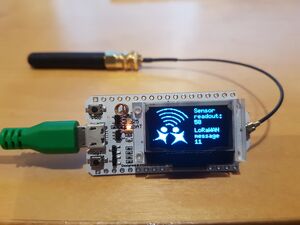
ESP32 mit LoRa Transceiver, WLAN - Gateways ab 100,-EUR ohne Outdoor-Gehäuse und Antennen
- Eigene Clients zum Basteln je nach Anwendung
- Anwendungen vor allem Sensordaten erfassen, Fernsteuern, Überwachen

Standorte
Bei 2km Reichweite in Städten würden wir mit den ersten drei Gateways schon die komplette Innenstadt abdecken.

Das erste Radio-Gateway hängt seit Anfang Mai auf Z10.

Plan / Offene Fragen
- Gateways aufstellen
- LoRaWAN Network Server bereitstellen
- Eventuell Anbindung an The Things Network oder eigene Systeme aufbauen
- Standorte so planen, dass gesamte Stadt abgedeckt wird
- Adressen und Einbindung in Opennet Netzwerkstruktur besprechen
Ausprobierte Hardware
- Unser erstes Gateway soll so aussehen: https://github.com/ttn-zh/ic880a-gateway/wiki
- Ein iC880A-SPI-Board - LoRaWAN Concentrator 868 MHz haben wir schon im Gehäuse - http://shop.imst.de/wireless-modules/lora-products/8/ic880a-spi-lorawan-concentrator-868-mhz
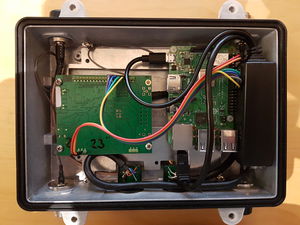
Prototyp eines LoRa-Gateways mit Raspberry Pi und LoRaWAN Concentrator (8 Kanäle) iC880A-SPI - Antenne mit N-Stecker für 868 MHz selbst gebaut - siehe Foto
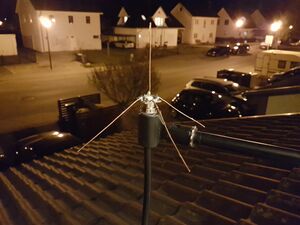
Selbstgebaute Groundplane-Antenne für 868 MHz und 50 Ohm Impedanz. - https://www.amazon.de/MakerHawk-Entwicklungsbrett-Bluetooth-Doppelkern-0-96inch/dp/B076T28KWG


- Fotos in der Gallery https://www.opennet-initiative.de/gallery/technik/Boards-Ger-te/LoRaWAN-Gateway
LoRa Endgeräte
- Ein auf ESP32 basierendes Developer Board dient zur Demonstration der Fähigkeiten von LoRa
- Anleitung zum Nachbau gibt es hier
Merkzettel
Hardware
Gateways
- http://www.dragino.com/products/lora/item/117-lg01-p.html
- Raspberry PI: cheap LoRa gateway https://electronza.com/raspberry-pi-cheap-lora-gateway/
- https://mikrotik.com/products/group/lora-products
Endgeräte
- Arduino, diverse "Shields" für Ardoino und Co.
- https://www.amazon.de/s/ref=nb_sb_noss?__mk_de_DE=ÅMÅŽÕÑ&url=search-alias%3Daps&field-keywords=lora+shield&rh=i%3Aaps%2Ck%3Alora+shield
- http://wiki.dragino.com/index.php?title=Lora_Shield
- https://stefan.schultheis.at/2018/lora-aprs-gw-raspberry-pi-zero/
- https://www.exp-tech.de/search?sSearch=dragino LoRa Starter Kit 868
- Raspberry
- Sonstiges
- https://www.elektormagazine.de/news/review-einstieg-ins-iot-mit-lora-produkten-von-dragino
- https://www.amazon.de/gp/product/B01N8SKD2I/ Pycom LoPy - IoT-Entwicklungsboard mit LoRa, WLAN und BLE
- https://www.thethingsnetwork.org/forum/t/big-esp32-sx127x-topic-part-1/10247/33
Server-Software
- App-Server z.B. auch via AWS https://www.hackster.io/naresh-krish/integrating-lorawan-with-aws-iot-services-using-the-rak811-b0127d
Sonstiges
- http://de.farnell.com/the-things-network/ttn-un-868/the-things-uno-eu/dp/2675815
- http://de.farnell.com/das-einmaleins-des-lorawan
- https://www.rs-online.com/designspark/building-a-raspberry-pi-powered-lorawan-gateway
- https://www.hackerspace-ffm.de/wiki/index.php?title=LoRaWAN
- https://lorenzadriaensen.com/cheap-ttn-node-rfm95w-arduino-pro-mini/